 By
By 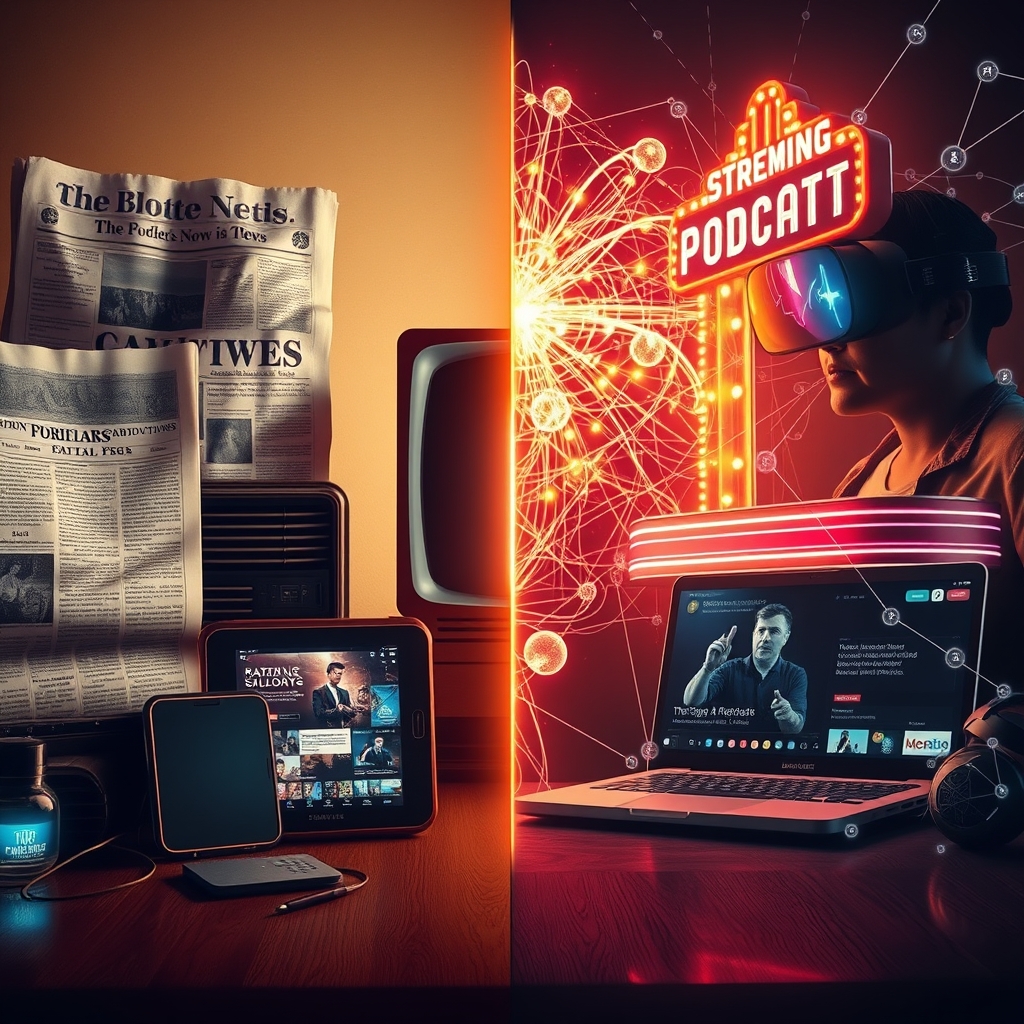
The advent of the internet and the subsequent explosion of social media platforms have not merely influenced; they have fundamentally re-engineered the operational viability and cultural resonance of traditional media stalwarts: newspapers, radio, television, and cinema. This seismic shift, characterized by unprecedented accessibility and democratized content creation, has forced these established institutions into a relentless struggle for relevance, revenue, and audience attention, often yielding outcomes that range from profound adaptation to existential threat.
The Newspaper: A Paradigm in Peril
No sector has felt the brunt of digital disruption more acutely than the newspaper industry. Once the primary purveyor of daily news and community discourse, print journalism has witnessed a precipitous decline in circulation and advertising revenue. The internet offered an immediate, free, and constantly updated alternative to the printed page, eroding the core value proposition of physical newspapers. Social media platforms, in particular, became the new town squares, where news, often unverified and sensationalized, spread with viral speed, dwarfing the reach and immediacy of even the most agile newspaper websites.
The transition to digital has been fraught with challenges. While many publications successfully established online presences, monetizing digital content proved an arduous task. The prevalent expectation of free online news, coupled with the dominance of tech giants in digital advertising, left many newsrooms financially emaciated. This financial strain has led to widespread layoffs, the closure of numerous local papers, and a general reduction in investigative journalism—the very bedrock of a healthy democracy. The analytical depth and verified reporting that once distinguished newspapers are now often lost amidst a cacophony of user-generated content and clickbait headlines, exacerbating issues of misinformation and the erosion of public trust in established news sources.
Radio’s Resilient Adaptation
Of the traditional media, radio has perhaps demonstrated the most surprising resilience, albeit through significant metamorphosis. Its initial vulnerability stemmed from the internet’s capacity for on-demand audio content and personalized playlists, directly challenging the linear, broadcast model. Services like Spotify and Apple Music offered unparalleled choice, while podcasts emerged as a formidable competitor for listener attention, providing niche content with deep dives into specific topics, a format traditional radio often struggled to replicate within its rigid scheduling.
However, radio’s inherent strengths—its portability, its local focus, and its ability to serve as a companion medium—have allowed it to adapt rather than crumble. Terrestrial radio stations have expanded their reach through online streaming, integrating social media for listener interaction and content promotion. The rise of podcasting, ironically, has also been embraced by many traditional broadcasters, who now produce their own on-demand content, leveraging established brands and talent. While advertising revenue models have shifted and audience fragmentation is undeniable, radio has managed to maintain a significant, albeit altered, presence by embracing digital distribution and focusing on its core strengths: live, local, and community-oriented content that is immediate and accessible.
Television’s Fragmented Future
Television, once the undisputed king of home entertainment and news dissemination, now navigates a landscape utterly transformed by streaming services and social media. The traditional model of scheduled programming, reliant on advertising breaks and cable subscriptions, has been systematically dismantled by the rise of platforms like Netflix, Hulu, and Disney+. These services offer vast libraries of on-demand content, often ad-free, at competitive prices, leading to the phenomenon of “cord-cutting” where consumers abandon traditional cable in favor of streaming.
Social media further fragments the audience, as viewers increasingly consume snippets of shows, discuss plot points in real-time, or even watch entire series through pirated clips shared across platforms. The communal experience of watching a prime-time show simultaneously has largely given way to individual, personalized viewing habits. For traditional broadcasters, this means a significant loss of advertising revenue and a desperate scramble to launch their own streaming platforms, often at substantial cost, in an attempt to retain market share. The challenge is not merely technological but cultural: the expectation of instant access, personalized recommendations, and an ad-light experience has become the norm, forcing television to fundamentally rethink its content strategy, distribution, and revenue generation.
Cinema: The Theatrical Experience Under Scrutiny
The cinema industry, with its reliance on the shared, immersive theatrical experience, has faced a different, yet equally profound, set of challenges. The convenience and quality of home entertainment systems, coupled with the rapid availability of new releases on streaming platforms, have steadily eroded the incentive for audiences to visit movie theaters. The COVID-19 pandemic accelerated this trend, forcing studios to experiment with simultaneous theatrical and streaming releases, further blurring the lines between the big screen and the living room.
Social media, while a powerful marketing tool for films, also contributes to the devaluation of the theatrical experience through rampant piracy and the immediate dissection of plot points, often spoiling narratives for those who have yet to see the film. The industry has increasingly leaned into event cinema—blockbuster franchises with visual spectacles that are difficult to replicate at home—as a means to draw audiences back to theaters. However, this strategy risks alienating original, smaller-budget films that struggle to find theatrical distribution and are increasingly relegated directly to streaming. The fundamental question for cinema remains whether the unique magic of the collective viewing experience can withstand the pervasive convenience and comfort of the digital home entertainment ecosystem.
The overarching narrative across all these traditional media forms is one of relentless disruption and forced evolution. The internet and social media have irrevocably altered the mechanisms of content creation, distribution, consumption, and monetization. While some have adapted with surprising agility, others grapple with an existential crisis, their traditional business models rendered obsolete. The shift from gatekeepers to open platforms, from scarcity to abundance, and from communal to personalized consumption, has not only redefined the media landscape but also profoundly reshaped how societies access information, engage with culture, and form shared understandings. The landscape is not merely altered; it is fundamentally redefined, demanding perpetual adaptation from those who seek to inform, entertain, or engage in this perpetually evolving digital age.




 By
By  By
By  By
By