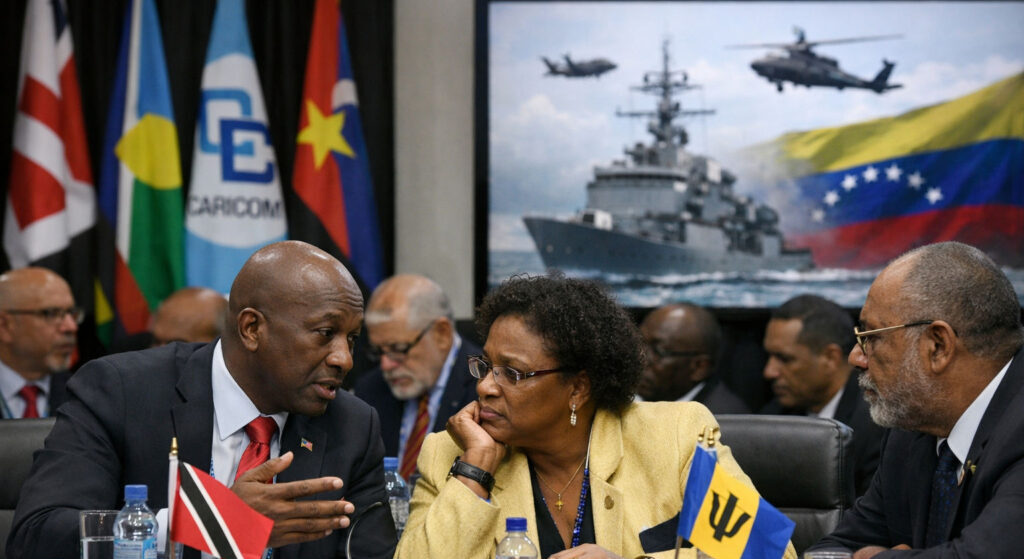
The Caribbean Community, commonly known as CARICOM, has long prided itself on unity, diplomacy, and the shared aspiration of maintaining the region as a “zone of peace.” Yet recent tensions surrounding U.S. military activity linked to Venezuela have exposed deep and potentially destabilizing divisions within the bloc. What was once a cohesive regional voice now appears strained, raising questions about whether CARICOM is approaching a critical moment—or even a possible fracture.
At the heart of the dispute is the growing military posture of the United States in the Caribbean. Since 2025, Washington has expanded its presence through naval deployments, air operations, and strategic positioning in territories close to Venezuela. These moves, justified by U.S. officials as counter-narcotics operations and pressure against the government of Nicolás Maduro, have increasingly been interpreted by regional observers as preparation for broader military action. (
Wikipedia)
Crucially, Washington has reportedly sought cooperation from Caribbean states, including access to facilities and logistical support. This has placed CARICOM members in a difficult position: whether to align with a powerful global actor or to uphold longstanding regional principles of non-intervention and sovereignty.
The result has been a visible split within the bloc.
Some countries have resisted U.S. overtures, emphasizing diplomacy and regional stability. CARICOM leaders have repeatedly expressed concern over escalating violence and reaffirmed their commitment to international law and peaceful resolution of disputes. (
The Washington Post) Their stance reflects a historical sensitivity to foreign intervention, rooted in the Caribbean’s colonial past and its ongoing efforts to assert political independence on the global stage.
However, not all member states share this perspective. Trinidad and Tobago has emerged as a notable outlier, openly supporting aspects of U.S. military policy. Its government has argued that stronger action is necessary to combat organized crime and narcotics trafficking, issues that have severely affected domestic security. This alignment with Washington has drawn sharp criticism from regional partners and has, in effect, broken the unified diplomatic front CARICOM has traditionally maintained. (
The Washington Post)
The divergence is not merely rhetorical. Venezuela has reacted strongly to perceived cooperation between Caribbean states and the U.S., suspending agreements and issuing warnings. (
Wikipedia) Meanwhile, internal disputes within CARICOM have intensified, with disagreements extending to leadership and governance issues within the organization itself. (
AP News) These developments suggest that the crisis is not only external but also institutional.
The geopolitical context further complicates matters. Venezuela’s strategic importance—due to its vast oil reserves and its position in South America—has drawn in global powers. Russia has criticized U.S. actions, while regional actors worry about being caught in a broader international confrontation. (
Reuters) For small island states with limited military capacity, the prospect of becoming staging grounds in a major conflict is deeply unsettling.
Economically, the stakes are equally high. Tourism, fisheries, and maritime trade—all vital to Caribbean economies—are already feeling the impact of increased militarization. Reports of deadly strikes on vessels in regional waters have heightened fear among local populations and disrupted livelihoods. (
The Washington Post) A prolonged conflict or escalation could have devastating consequences for economies that are still recovering from global shocks.
Yet it would be premature to declare CARICOM’s imminent collapse. The organization has weathered disagreements before, often relying on quiet diplomacy and consensus-building to bridge divides. The current crisis, however, is different in scale and urgency. It touches on fundamental questions: What does regional unity mean in an era of renewed great-power competition? Can small states maintain neutrality when external pressures intensify? And how far should individual members go in pursuing national interests at the expense of collective positions?
There are signs that CARICOM leaders recognize the gravity of the moment. At recent summits, calls for de-escalation, dialogue, and a coordinated regional response have taken center stage. (
The Guardian) Whether these efforts can restore cohesion remains uncertain.
What is clear is that CARICOM stands at a crossroads. The decisions made now—regarding military cooperation, diplomatic alignment, and internal solidarity—will shape the organization’s future. A unified approach could reinforce the Caribbean’s role as a moral and diplomatic voice on the global stage. A fragmented one, by contrast, risks diminishing its influence and exposing its members to external manipulation.
In the end, the question is not simply whether CARICOM will break apart. It is whether it can adapt to a rapidly changing geopolitical environment without losing the principles that have defined it for decades. The coming months may well determine whether the Caribbean remains a cohesive community—or becomes another fault line in an increasingly divided world.